IKLAN

Saturday, July 25, 2009

Silat tanpa ilmu batin


Kemunculan pelbagai jenis seni mempertahankan diri di negara ini menyaksikan silat semakin bergelut untuk terus dipraktikkan oleh generasi muda. Bagaimanapun, perkembangannya di peringkat Nusantara dan dunia nyata lebih membanggakan.


"TIDAK akan Melayu hilang di dunia." Demikian kata-kata hikmat yang keluar dari mulut Laksmana Hang Tuah.

Pahlawan yang menjadi legenda dalam sejarah Melayu itu merupakan seorang yang memiliki pelbagai ilmu persilatan yang tinggi tanpa tolok bandingnya.

Hakikatnya, silat bukan hanya ilmu mempertahankan diri tetapi dianggap sebagai lambang keperibadian bangsa dan seni budaya Melayu yang sudah sebati sejak zaman dahulu lagi.

Seni mempertahankan diri itu juga memainkan peranan yang cukup besar untuk membentuk angkatan pertahanan negara sejak kerajaan Melayu Langkasuka, Gangga Negara, Champa, Kemboja, Patani, Beruas, Minangkabau, Srivijaya, Majapahit, Melaka dan lain-lain negeri yang terletak di dalam Kepulauan Melayu, Nusantara.

Fakta sejarah menceritakan, Sultan Muhammad Shah (Sultan Melaka Ketiga) pernah melantik seorang rakyat Champa sebagai pegawai kanan istana kerana memiliki kemahiran dalam ilmu persilatan.

Sehingga kurun ke-19, pendidikan silat terus berkembang dan berjaya melahirkan ramai pemimpin perang Melayu untuk menentang penjajah seperti Mat Kilau, Datuk Bahaman, Datuk Sago, Tok Janggut, Raja Haji, Mat Salleh dan sebagainya.

Pada zaman pemerintahan komunis pula, dipertemukan dengan tokoh seperti Kiai Salleh, Kiai Osman, Kiai Shamsuddin Abbas dan sebagainya.

Pada zaman penjajahan Inggeris di Tanah Melayu, ilmu persilatan tetap disampaikan kepada masyarakat melalui pendidikan silat gelanggang bangsal yang dikendalikan oleh guru-guru silat yang mahir.

Selepas Tanah Melayu mencapai kemerdekaan pada tahun 1957, terdapat ratusan aliran perguruan silat di Malaysia.


PESILAT Malaysia, Emy Latip (kiri) melepaskan tendangan ke arah pesilat Vietnam, Nguyen Thi Nhu Quynh di Kuala Terengganu.


Bagi tujuan membina, menyusun dan mengurus dengan baik, kerajaan telah mengarahkan pengamal-pengamal silat mewujudkan persatuan dan didaftarkan.

Usaha itu telah melahirkan Majlis Seni Silat Malaysia pada tahun 1983 sebelum ditukar kepada Persekutuan Silat Kebangsaan Malaysia (Pesaka), tiga tahun kemudian.

Pesaka dianggotai oleh empat persatuan silat iaitu Seni Gayung Fatani Malaysia, Silat Seni Gayung Malaysia, Silat Lincah Malaysia dan Silat Cekak Malaysia.

Sementara itu, perguruan silat lain menjadi anggota Pesaka negeri yang diwujudkan di setiap negeri.

Kini, silat yang suatu masa dahulu hanya diamalkan oleh dunia Melayu di rantau ini telah berkembang dengan meluasnya sehingga ke seluruh pelosok dunia.

Melalui Persekutuan Pencak Silat Antarabangsa (Persilat), silat terus mengembara ke serata dunia menerusi penganjuran pertandingan seperti Kejuaraan Pencak Silat Sedunia, Sukan SEA dan Kejuaraan Pencak Silat Eropah

Bagaimanapun, silat untuk tujuan pertandingan tidak boleh menggunakan unsur-unsur ilmu kebatinan.

Yang Dipertua Persatuan Seni Silat Negeri Terengganu (Pesilat), Datuk Zubir Embong berkata, silat harus memainkan peranan serampang dua mata.

"Kita perlu melihat silat dalam dua konteks yang berbeza iaitu bagi tujuan penyuburan budaya bangsa Melayu dan kemajuan sukan.

"Jika ia hanya menjadi ilmu mempertahankan diri, ia akan mendatangkan kebosanan kepada pengamal-pengamal silat," katanya ketika ditemui Kosmo! pada Kejuaraan Pencak Silat Jemputan ASEAN Pertama Terengganu-Malaysia 2009 di Stadium Tertutup Kompleks Sukan Negeri, Kuala Terengganu baru-baru ini. Kejuaraan itu telah dirasmikan oleh Pengerusi Jawatankuasa Belia dan Sukan Negeri Terengganu, Datuk Abdul Rahin Said.


SENI mempertahankan diri silat tetap subur di negara ini.


Zubir berkata, silat akan terus berkembang di negara ini meskipun seni mempertahankan diri itu mengalami transformasi dalam aspek peranan dan makna sosiobudaya Melayu. Katanya, transformasi itu perlu agar ia sesuai dengan peredaran zaman dan keperluan masyarakat.

Sehingga hari ini, masih terdapat banyak pusat perguruan yang mengajar ilmu persilatan kepada individu yang berminat termasuk remaja.

Bagaimanapun, guru-guru silat hari ini tidak lagi mengajar ilmu-ilmu kebatinan seperti mana yang diamalkan oleh tokoh-tokoh perjuangan pahlawan Melayu zaman dahulu.

Guru-guru silat hari ini lebih banyak tertumpu pada ilmu persilatan untuk tujuan pertandingan.

Hari ini juga menyaksikan seni mempertahankan diri yang menjadi tradisi orang Melayu akan dikuasai negara-negara yang tidak mempunyai latar belakang ilmu persilatan.

Buktinya, Vietnam kini muncul sebagai satu kuasa baru dalam sukan silat yang suatu ketika dahulu hanya dikuasai oleh negara seperti Malaysia, Indonesia, Singapura dan Brunei.

Mengulas lanjut, Zubir berkata, ada kemungkinan seni budaya masyarakat Melayu ini akan hilang identitinya jika tiada tindakan segera diambil oleh pemimpin-pemimpin negara.

Di Singapura, silat lebih diminati berbanding seni mempertahankan diri yang lain seperti taekwondo dan karate.

Pengurus dan Jurulatih Pasukan Silat Singapura, Abdul Raziz Mohd. Hussain, 54, berkata, setakat ini program pembangunan silat di negara itu berjalan lancar.

Selain mendapat peruntukan kerajaan, pengamal-pengamal pusat perguruan silat di Singapura juga aktif menjalankan tanggungjawab mereka untuk menanam minat generasi muda terhadap silat.


ABDUL Rahin memukul gong bagi merasmikan Kejuaraan Pencak Silat Jemputan ASEAN Pertama di Kuala Terengganu.


Katanya, terdapat lebih daripada 30 pusat perguruan yang aktif di negara itu.

Bagaimanapun, Singapura juga berdepan dengan senario yang sama dengan Malaysia apabila menghadapi kesukaran untuk melahirkan pesilat yang hebat bagi mengekang penguasaan Vietnam.

"Sistem pendidikan di Singapura menjadi faktor utama yang menghalang usaha kami untuk melahirkan pesilat yang baik di peringkat antarabangsa.

"Selalunya, pesilat-pesilat di Singapura lebih banyak memberi tumpuan terhadap pelajaran sebaik sahaja mencapai usia 17 tahun," katanya.

Bagaimanapun katanya, silat tetap akan subur di Singapura selagi wujudnya pusat-pusat perguruan yang mengambil inisiatif sendiri untuk mengajar ilmu persilatan.

Sementara itu, di Brunei, silat masih lagi menjadi amalan masyarakat Melayu di negara itu.

Pengurus Pasukan Silat Brunei, Mohd. Rushdi Abdullah berkata, silat masih menjadi antara seni mempertahankan diri nombor satu di Brunei.

"Prestasi pasukan silat kami semakin menunjukkan peningkatan selepas kami menerima sentuhan jurulatih dari Indonesia pada tahun 2008 lalu.

"Silat yang diajar kini tidak menonjolkan ilmu kebatinan kerana dalam pertandingan, pesilat perlu mematuhi peraturan-peraturan yang ditetapkan," katanya.

Mohd. Rushdi berkata, orang Melayu di rantau Nusantara tetap akan menguasai ilmu persilatan meskipun silat telah tersebar luas ke Eropah.

Katanya, berbanding negara-negara yang tidak mempunyai latar belakang silat yang hanya belajar untuk tujuan pertandingan, negara-negara di kepulauan Melayu Nusantara belajar silat untuk mempertahankan ilmu kepahlawanan atau seni perang Melayu ini.

Sumber: Kosmo Online!

Wednesday, July 22, 2009

Silat Olahraga


Silat olahraga atau nama lainnya tanding merupakan sebuah konsep yang diwujudkan bagi para pesilat beradu tenaga dan bertanding berpandukan kepada peraturan supaya permainan menjadi lebih adil dan selamat. Antara yang terlibat dalam mengasaskan silat olaharga pada ketika itu ialah Guru Anuar Wahab yang merupakan wakil kepada PESAKA (Persekutuan Silat Kebangsaan).

Di dalam setiap permainan silat olahraga hanya dua orang peserta dibenarkan bertanding. Kedua-dua pesilat akan memakai pakaian silat masing-masing beserta alat perlindungan yang ditetapkan. Mereka akan berusaha untuk mengutip mata di antara satu sama lain melalui serangan seperti tumbukan, sepakan, kuncian, sapuan ataupun jatuhan. Setiap permainan akan diadili oleh seorang wasit (pengadil) dan beberapa orang juri.

Silat olahraga memiliki keunikan dan kelebihannya yang tersendiri berbanding dengan seni mempertahankan diri yang lain. Untuk memenangi setiap permainan, para pesilat perlu menggunakan kebijaksanaan seiring dengan kekuatan bagi mematahkan setiap serangan lawan. Dalam erti kata lain, silat ini bukanlah diwujudkan sekadar untuk beradu tenaga semata-mata tetapi bagi melatih dan mempraktikkan segala kemahiran yang dipelajari oleh setiap pesilat agar dapat digunakan dengan baik. Silat olahraga kini telah banyak diangkat dan dipertandingkan dalam acara dan kejohanan yang bertaraf kebangsaan dan antarabangsa seperti Sukan Malaysia, Sukan Sea dan Kejohanan Pencak Silat Dunia.

History of Silat

Silat Melayu is a blanket term for the types of silat created in peninsular Southeast Asia, particularly Malaysia, Thailand, Brunei and Singapore. The term is most often used to differentiate Malaysian styles from Indonesian pencak silat.

Terminology

The etymological root of the term silat is uncertain and most hypotheses link it to any similar-sounding word. One prominent theory is that silat derives from sekilat which means "as (fast as) lightning". This may have been used to describe a warrior's movements before eventually being shortened to silat. Some people believe it comes from si elat which means someone who confuses, deceives or bluffs. A similar term, ilat, means an accident, misfortune or a calamity.[1]Terms other than silat are used in certain regions where it carries a specific or special meaning. For example, the term gayung is generally used in the north of the Malay Peninsula. The word gayung refers to the spiritual practices in silat.

The word Melayu means Malay and comes from the Sanskrit term Malai Ur which can translate as "land of mountains", the word used by Indian traders when referring to peninsular Malaysia. Silat Melayu is sometimes mistakenly called bersilat. This is actually a verbal form of the word silat and refers to the act of using silat in combat or for performance.

History

Origins


Hang Tuah training with his friends

The first martial skills in the Malay Peninsula were those of the orang asal (indigenous tribes) who would use hunting implements like spears, machetes, blowpipes and bows and arrows in raids against enemy tribes. Certain tribes were well-known warriors and pirates such as the Iban and the Tringgus of Borneo. Aboriginal populations on the peninsula were mostly replaced by Deutero-Malays from Sumatra and Borneo and Chamic peoples from Thailand. These settlers were rice-farmers from whom modern Malays are directly descended. The areas from where they originated are concurrent with the early evidence of silat. Sumatra was the birthplace of much of what constitutes Malay culture, particularly the Malay language. The Chams (Vietnamese Malays) of Dongson are believed by many archaeologists to have created the prototype of a kris as far back as 2000 years ago.

The Malays had established regular contact with both India and China at least since the 1st century. Silat was largely shaped by Chinese and Indian martial arts, as evidenced by Kedah's 5th century Bujang Valley civilisation which housed various Indian weapons including an ornate trisula. Their influence resulted in the founding of other Hindu-Buddhist kingdoms throughout the region. The oldest among them was Funan, a Cambodia-based empire that ruled over an area including what is now northern Malaysia, Thailand and Laos. Another was Gangga Negara (lit. Ganges country) that was founded in present-day Beruas by the Khmer prince Raja Ganji Sarjuna.[2] and served as an important trading port before being destroyed by Raja Chola Rajendran of Tamil Nadu. Even today, most Malaysian Indians are Tamils, who influenced several Southeast Asian martial arts through silambam. This staff-based fighting style was already being practiced by the region's Indian community when Melaka was founded at the beginning of the 1400s. During the 1700s silambam became more prevalent in the Malay Peninsula than in India, where it was banned by the British government.[3] The bamboo staff is still one of silat's most fundamental weapons.

In south-central Vietnam the Cham Malays founded their own kingdom of Champa, which remained independent from the Chinese who controlled Vietnam's north. In its refusal to submit, the kingdom of Champa frequently waged wars against China.[4] Commanders of Champa are known to have been held in high esteem by the Malay kings for their knowledge in silat and for being highly skilled in the art of war, as shown in the Sejarah Melayu (Malay Annals) where it is told that Sultan Muhammad Shah had chosen a Cham official as the right hand or senior officer because the Chams possessed skill and knowledge in the administration of the kingdom.[5]

One Malaysian variant of an Indonesian story explains that the first complete system of silat was created by a woman who was carrying a basket of food on her head when birds tried to steal the food from her. She dodged the birds coming from all directions while at the same time attempting to chase them away with her hands. She arrived home late and was scolded by her husband who had no food to eat. He tried to beat the woman but she avoided all his attacks and was completely untouched. Her husband had grown tired and after listening to her explanation for being late, asked his wife to teach him what she had learned. Together they founded the first form of silat. By the 7th century silat had already spread throughout the Malay Peninsula. The styles created on the peninsula are now called Silat Melayu or seni silat to differentiate them from the pencak silat of Indonesia. Tradition credits silat tua (lit. "old silat") as the first system of silat Melayu to have been founded on the peninsula. This border area between Malaysia and Thailand where it was created is culturally significant and considered to be the "cradle of Malay custom".


King bestowing Hang Tuah with the rank of Laksamana (admiral)

Over time, silat was refined into the specialized property of royalty, pendekar, and generals. Kings encouraged princes and children of dignitaries to learn silat and any other form of knowledge related to the necessities of combat. Prominent fighters were elevated to head war troops and received ranks or bestowals from the raja.[6] One of these was the famous 15th-century Melakan warrior Hang Tuah. He learned martial arts together with his four compatriates - Hang Jebat, Hang Lekir, Hang Kasturi and Hang Lekiu - from two of the most renowned silat gurus of the era. In Malaysia today, Hang Tuah is called the "father of silat"[7] for his contribution to the art's dissemination.

Colonial period

In the 16th century, conquistadors from Portugal attacked Melaka in an attempt to monopolise the spice trade. The Malay warriors managed to hold back the better-equipped Europeans for many days before Melaka was eventually defeated. The Portuguese hunted and killed anyone with knowledge of martial arts so that the remaining pesilat fled to more isolated areas. Even today, the best silat masters are said to come from areas that have had the least contact with outsiders. For the next few hundred years, the Malay Archipelago would remain under a string of foreign rulers, namely the Portuguese, Dutch, and finally the British. The 1600s saw an influx of Minangkabau and Bugis people into Melaka from Sumatra and south Sulawesi respectively. Bugis sailors were particularly well-known for their martial prowess and were feared even by the European colonists. In the 18th century both groups were engaged with the Dutch in a triangular contest for control of the Melaka Straits. By the 1780s the Bugis had control of Johor and established a kingdom in Selangor. The Minangkabau formed their own federation of nine states called Negeri Sembilan in the hinterland. Today, many of Malaysia's silat schools can trace their lineage directly back to the Minang and Bugis settlers of this period.

After Malaysia achieved independence, Tuan Haji Anuar bin Haji Abd. Wahab was given the responsibility of developing Malaysia's national silat curiculum which would be taught to secondary and primary school students all over the country. On 28 March 2002, his Seni Silat Malaysia was recognised by the Ministry of Heritage and Culture, the Ministry of Education and PESAKA as Malaysia's national silat. In Malaysia, silat is not only an art of self-defence but is also a symbol of the Malay ethno-cultural persona which, through the rise and fall of Malay kingdoms, has endured the trials and tribulations in fighting for the Malay people. [8] The colonial period and communist era saw figures such as Mat Kilau, Dato' Sago, Tok Janggut, Kiai Samsuddin, Raja Haji and Kiai Salleh who continuously invigorated and instilled the spirit of love for the country and "fighting til the last drop of blood". They are among several names whose eminence is related to silat and other such knowledge that allowed them to become effective leaders.[9] . Since its disassociation with the palace, silat did not develop in the national defence institution and returned to the countryside. It is now conveyed to the community by means of the gelanggang bangsal meaning the martial arts training institution carried out by silat instructors.[10] From the time of British rule until today, silat continues to be left out of the national educational curriculum. However, it still serves as a way of contributing to the nation and is an alternative to joining the police or the Malay soldiers' regiment. The knowledge of silat will help them become good officers and workers who are productive.[11]

Clothing

Silat attire varies according to style and locality. People of the Malay Peninsula traditionally wore sarongs and carried a roll of cloth which could be used as a bag, a blanket or a weapon. The standard full dress of today's silat practitioners usually consists of the following:

  • The tengkolok is a headkerchief with different ways of tying it depending on status and region.
  • The baju Melayu, meaning "Malay shirt" is the male costume. The female equivalent is called baju kurung.
  • The samping is a waistcloth.
  • The bengkung is a cloth belt or sash which secures the samping. Some schools colour the bengkung to signify rank, a practice adopted from the belt system of Japanese martial arts.

Music


Basic gendang set

Silat performances are often accompanied by a live band playing music known as gendang baku or gendang silat baku. The main instruments are the gendang (drums), gong and serunai (oboe). Types of silat drums include the gendang ibu or "mother drum" and the gendang anak or "child drum". The serunai, which also comes in long and short variations, is what gives silat music its distinct sound.


Gendang silat sample

As with a tomoi match, the speed of the music adapts to the pesilat's pace. Melodies and instruments differ from one area to another. Areas with a strong Indonesian influence usually play the instruments of gamelan (Javanese orchestra) while those of northern regions are more similar to Thai music.


Weapons


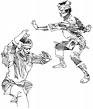
Defense using langkah
  • Kris/Keris: A dagger which is often given a distinct wavy blade by folding different types of metal together and then washing it in acid.
  • Parang/Golok: Machete/ broadsword, commonly used in daily tasks such as cutting through forest growth.
  • Tombak/Lembing: Spear/ javelin, made of wood, steel or bamboo that may have dyed horsehair near the blade.
  • Tongkat: A walking-stick carried by travellers and the elderly.
  • Batang/Galah: Staff or rod made of bamboo, steel or wood.
  • Kayu: Wooden stick of any size.
  • Gedak: A mace or club of Indian origin.
  • Pisau/Sundang: A sword or knife, either single or double edged.
  • Badek/Badik: One-sided knife ranging in length from 20-40cm.
  • Seligi: Sharpened bamboo shaft used as a javelin or spear.
  • Kerambit: A concealable claw-like curved blade that can be tied in a woman's hair.
  • Sabit: Sickle commonly used in farming, harvesting and cultivation of crops.
  • Serampang/Trisula: Trident originally used for fishing.
  • Tekpi/Chabang: Three-pronged truncheon thought to derive from the trident.
  • Chindai/Sarung: Wearable silk fabric used to lock or defend attacks from bladed weapons.
  • Rantai: Chain used for whipping and seizing techniques

References

  1. ^ Silat Dinobatkan Seni Beladiri Terbaik by Pendita Anuar Abd. Wahab AMN (pg. 42 SENI BELADIRI June 2007, no: 15(119) P 14369/10/2007)
  2. ^ Sejarah Melayu by A. Samad Ahmad
  3. ^ Crego, Robert (2003). Sports and Games of the 18th and 19th Centuries pg 32. Greenwood Press
  4. ^ Thesis: Seni Silat Melayu by Abd Rahman Ismail (USM 2005 matter 188)
  5. ^ Sejarah Melayu by A. Samad Ahmad 1996: matter 75
  6. ^ Thesis: Seni Silat Melayu by Abd Rahman Ismail (USM 2005 matter 188)
  7. ^ Sheikh Shamsuddin (2005). The Malay Art Of Self-defense: Silat Seni Gayong. North Atlantic Books. ISBN 1556435622.
  8. ^ Martabat Silat Warisan Negara, Keaslian Budaya Membina Bangsa PESAKA (2006) [Sejarah Silat Melayu by Tn. Hj. Anuar Abd. Wahab]
  9. ^ Martabat Silat Warisan Negara, Keaslian Budaya Membina Bangsa PESAKA (2006) [Sejarah Silat Melayu by Tn. Hj. Anuar Abd. Wahab]
  10. ^ Martabat Silat Warisan Negara, Keaslian Budaya Membina Bangsa PESAKA (2006) [Sejarah Silat Melayu by Tn. Hj. Anuar Abd. Wahab]
  11. ^ "Martabat Silat Warisan Negara, Keaslian Budaya Membina Bangsa" PESAKA (2006) [Istilah Silat by Anuar Abd. Wahab]
  12. ^ Dewan Bahasa dan Pustaka Dictionary (Teuku Iskandar 1970)
  13. ^ Martabat Silat Warisan Negara, Keaslian Budaya Membina Bangsa PESAKA (2006) [Istilah Silat by Anuar Abd. Wahab]
  14. ^ Martabat Silat Warisan Negara, Keaslian Budaya Membina Bangsa PESAKA (2006) [Istilah Silat by Anuar Abd. Wahab]